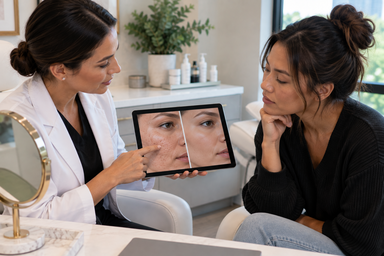
If you have ever stood in front of a bathroom mirror tilting your face under the light, trying to figure out whether that mark on your cheek is a scar or just leftover redness, you are not alone. It is one of the most common questions we hear from patients across Decatur, Georgia, and honestly, it is a fair one. Acne is frustrating enough while it is happening. What it leaves behind can feel even harder to deal with, especially when you are not sure if it is permanent or just needs more time.
The truth is that not every mark from a breakout is a true scar, and not every scar needs professional treatment. But some do, and knowing the difference can save you months of guessing (and a lot of unnecessary skincare purchases). This guide walks through why acne scars form, how to tell them apart from temporary discoloration, and what actually works when it is time to bring in a dermatology team. Updated this September 2026 with current guidance from our Decatur practice.
Why Do Acne Scars Form in the First Place?
Acne scars form when inflammation from a breakout damages the deeper layers of skin, disrupting the normal collagen production that would otherwise heal the area smoothly. The deeper or more inflamed the breakout, the more likely it is to leave a lasting mark. This is why a small whitehead rarely scars, but a deep, cystic pimple often does.
Several factors make scarring more likely. Picking, popping, or squeezing a blemish increases trauma to the skin and raises the risk of a permanent mark, even when it feels satisfying in the moment. Waiting too long to treat active, inflammatory acne allows breakouts to linger and do more damage. Genetics also play a real role. Some people simply produce collagen differently during the healing process, which is why two people can have similar breakouts and end up with very different results. Hormonal acne, which tends to show up along the jawline and chin, can also be more prone to scarring because those breakouts often run deeper.
What Are the Different Types of Acne Scars?
Acne scars generally fall into two broad categories: depressed (atrophic) scars, which create an indentation in the skin, and raised (hypertrophic or keloid) scars, which sit above the skin's surface. Depressed scars are far more common on the face, while raised scars tend to appear more often on the chest and back.
Within depressed scars, dermatologists often describe a few subtypes. Ice pick scars are narrow and deep, boxcar scars have sharper, more defined edges, and rolling scars create a wavy, uneven texture across the skin. Each type responds a little differently to treatment, which is part of why an in-person evaluation matters more than trying to self-diagnose from a search engine.
Is That Really a Scar, or Just a Mark That Will Fade?
Not every discoloration left behind by a pimple is a permanent scar. Post-inflammatory hyperpigmentation (a flat brown or dark mark) and post-inflammatory erythema (flat redness) are both extremely common after a breakout, and they typically fade on their own over several weeks to several months.
The key difference is texture. If you run your fingers over the area and the skin feels smooth, even if it is discolored, it is very likely a temporary mark rather than a true scar. True scarring involves a change in texture, whether that is an indentation, a raised bump, or a pitted appearance. If a mark has not faded after four to six months, or if you notice any change in texture, that is generally a good sign it is time to have it looked at rather than continuing to wait it out.
Do I Need to Treat My Active Acne Before Treating Scars?
Yes. Treating any active, ongoing acne is an essential first step before addressing existing scars, because new breakouts will continue creating new scars while you work on old ones. It also allows the skin to calm down enough for scar treatments to work more effectively and predictably.
This is one of the most overlooked parts of acne scar treatment. Jumping straight to a laser or resurfacing procedure while breakouts are still active can lead to inconsistent results and, in some cases, further irritation. Our team starts by getting active acne under control, whether that involves topical treatments, oral medications, or a combination approach, before moving into any cosmetic scar treatment. You can read more about how we approach ongoing breakouts on our page dedicated to acne treatment.
What Acne Scarring Looks Like for Teens and Young Adults Right Now
Acne scarring can carry a different kind of weight for teens and young adults today, and it is worth naming that honestly. Social media has normalized "popping" videos and close-up skin content in a way that can encourage picking habits, while filtered, airbrushed photos set an unrealistic bar for what skin is supposed to look like. For a teenager already navigating school, friendships, and everything else that comes with that age, visible scarring can genuinely affect confidence.
We are not going to pretend that is a small thing, and we are not offering it as medical or mental health advice here. What we can say is that it helps to know real, effective options exist, and that scarring is not something a young patient has to just live with or hide under makeup indefinitely. Getting active breakouts under control early, and avoiding the temptation to pick, goes a long way toward preventing new scars from forming in the first place. From there, our Decatur team can walk families through age-appropriate options that fit a teen's skin and lifestyle.
How Is Acne Scar Treatment Done in a Dermatology Setting?
Professional acne scar treatment typically involves in-office procedures designed to stimulate collagen remodeling and smooth out uneven texture, most commonly through targeted laser therapy. The right approach depends on your scar type, skin tone, and how your skin has responded to treatment in the past.
At our Decatur practice, laser treatments are one of the primary tools we use to address textural scarring, since they work by encouraging the skin to rebuild collagen in a more organized way. We also offer options through Cutera laser and light therapy, which can be tailored to different scar types and skin concerns. For patients looking at broader skin texture and tone improvement alongside scar treatment, our face and body rejuvenation services offer additional options worth discussing during a consultation.
How Many Treatments Will I Need, and What Should I Expect Afterward?
Most acne scar treatments require multiple sessions spaced several weeks apart to achieve noticeable improvement, and results build gradually as the skin remodels itself over time. This is not an overnight fix, but a process.
Recovery time varies depending on the specific treatment used, with some options requiring little to no downtime and others needing a few days for redness to settle. During your consultation, our providers will walk you through a realistic timeline based on your scar type and treatment plan, so you know what to expect before you start rather than being surprised partway through.
Frequently Asked Questions
Can acne scars be completely removed? Most treatments significantly improve the appearance of acne scars rather than erasing them entirely. The goal of professional acne scar treatment is to smooth texture and blend scarred areas with the surrounding skin so they are far less noticeable.
How long after a breakout should I wait before scars are considered permanent? If a mark has not faded within four to six months and it involves a change in skin texture rather than just color, it is worth having a dermatologist evaluate it rather than assuming it will disappear on its own.
Is laser treatment for acne scars painful? Most patients describe a warming or mild stinging sensation during laser treatments rather than significant pain, and numbing options are often available to keep you comfortable throughout the session.
Can I get acne scar treatment if I still have active breakouts? Active acne generally needs to be managed first, since new breakouts can create new scars and interfere with how well the skin responds to scar-focused treatment.
Are acne scar treatments safe for teens? Many treatment options can be appropriate for teens once active acne is under control, and our providers tailor recommendations based on age, skin type, and scarring severity during a one-on-one consultation.
The Bottom Line on Bouncing Back From Breakouts
Acne scars are common, they are not a reflection of anything you did wrong, and in most cases they are treatable. The first step is figuring out whether you are dealing with true scarring or a mark that simply needs time, and the second step is getting a plan that starts with calming active acne before moving into scar-specific treatment.
If you are in Decatur, Georgia and ready to talk through your options, our team is here to help you figure out what is actually going on with your skin and what a realistic treatment path looks like. Explore our full range of services, or visit Derm Associates of Georgia to learn more about our providers. When you are ready to take the next step, you can request an appointment with our Decatur team.

.svg)
.svg)