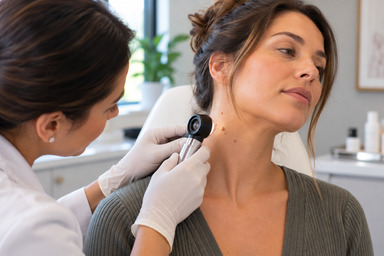
You are getting dressed, buttoning a collar or fastening a necklace, and your fingers brush against a small, soft bump you swear was not there a year ago. It does not hurt. It is not red or angry looking. But now that you have noticed it, you cannot stop noticing it, and you start wondering what it actually is.
For most people in Decatur, Georgia, that little bump is a skin tag, one of the most common and least talked about skin concerns out there. They show up quietly, they are almost always harmless, and yet they raise a surprising number of questions once someone actually spots one on their own body. What caused it? Is it something to worry about? Can it be removed, and should it be?
This guide walks through what skin tags are, why they form, how to tell them apart from something that needs closer attention, and why more people, especially teens and young adults chasing viral removal hacks online, should think twice before handling them at home. Updated this September 2026, this is meant to give Decatur residents a clear, practical answer to a question a lot of people quietly Google.
What Exactly Is a Skin Tag?
A skin tag, medically known as an acrochordon, is a small, soft, flesh colored or slightly darker growth of skin that typically hangs off a thin stalk. They range from the size of a grain of rice to about the size of a small grape and are made up of collagen fibers and blood vessels wrapped in a layer of skin.
Skin tags are not a disease or an infection. They are simply extra tissue growth, and they tend to show up in areas where skin regularly rubs against skin or clothing, such as the neck, armpits, eyelids, under the breasts, and groin folds. Once you know what to look for, they are usually easy to identify by their soft texture and the way they seem to dangle rather than sit flat against the skin.
Why Do Skin Tags Form in the First Place?
Skin tags develop mainly from friction, hormonal changes, and genetics, and they become more common as people move through their thirties, forties, and beyond. Several everyday factors tend to work together to cause them.
Does Friction and Skin Rubbing Cause Skin Tags?
Yes, repeated skin on skin or skin on fabric friction is one of the most common triggers. This is why skin tags so often appear in body folds, along bra lines, on the neck where jewelry or collars rub, or in areas where clothing fits snugly throughout the day.
Can Weight Change or Hormones Play a Role?
Weight gain and hormonal shifts, including those during pregnancy, are strongly linked to skin tag development. Extra skin folds create more friction points, while hormonal fluctuations can encourage skin cell growth, which is why many women notice new skin tags during pregnancy or after significant weight changes.
Is There a Genetic Component?
Genetics matter quite a bit here. If a parent or sibling tends to develop skin tags, there is a good chance you will too, since skin type and collagen behavior are inherited traits. Age is a factor as well, with skin tags becoming increasingly common after age 40 as skin loses some elasticity and folds become more pronounced.
Are Skin Tags Dangerous?
Skin tags themselves are almost always benign and pose no real health risk. That said, the concern is not usually the skin tag itself, it is making sure a new growth actually is a skin tag and not something that needs medical attention.
Skin tags can sometimes be confused with other growths, including moles, warts, or in rare cases something that warrants a closer dermatological look. A growth that changes shape, bleeds without being irritated, grows quickly, or has an uneven or dark border deserves a professional opinion rather than a guess. This is exactly the kind of evaluation the team at Derm Associates of Georgia provides, and it is why a proper mole check matters even when you are fairly confident something is "just" a skin tag.
When Should You Have a Skin Tag Checked or Removed in Decatur?
You should have a skin tag evaluated professionally if it is changing in appearance, causing repeated irritation from clothing or jewelry, or if you simply are not sure what it is. A dermatology provider can confirm the diagnosis and remove it safely in the same visit if needed.
Common reasons Decatur patients come in include skin tags that:
- Catch on necklaces, zippers, or bra straps and become irritated or bleed
- Have grown noticeably larger or changed color over a few months
- Sit somewhere cosmetically bothersome, like the eyelid or neck
- Appear in clusters that make a patient uneasy about their overall skin health
In these cases, a visit for cyst and mole removal or a general mole check allows a provider to look at the growth directly, rule out anything more serious, and remove it using a safe, appropriate in-office method if that is the right next step.
Why Are Skin Tag "Removal Hacks" Going Viral, and Why Are They Risky?
Skin tag removal videos have become a genuine trend among teens and young adults online, with tutorials showing people tying dental floss or string around the base of a skin tag to cut off blood flow, using over the counter freezing kits, or in more alarming cases, snipping them off with nail clippers or cuticle scissors at home. These videos rack up millions of views, but they leave out the risks that come with treating your own skin outside a clinical setting.
The problem is not just squeamishness, it is safety. Attempting to remove a skin tag at home can lead to infection if the area is not properly cleaned and cared for afterward, excessive bleeding since some skin tags have more blood supply than they appear to, and scarring that would not happen with a proper in-office removal technique. There is also a more important risk hiding underneath all of it: misidentification. A growth that looks like a simple skin tag online tutorials describe can occasionally turn out to be a different type of skin growth altogether, and cutting into it at home means skipping the one step that actually matters, having a trained eye look at it first.
For young people especially, curiosity and a five minute video should not replace an actual skin check. A quick, low pressure visit with a Decatur dermatology provider is a far safer way to deal with an unwanted skin tag than a bathroom mirror and a pair of nail clippers.
What Does Professional Skin Tag Evaluation and Removal Look Like?
A professional evaluation starts with a provider visually examining the growth, confirming it is in fact a skin tag rather than a mole or other lesion, and then discussing whether removal makes sense. If removal is appropriate, it is done in office using sterile, controlled techniques suited to the size and location of the growth.
This is a quick, low downtime process compared to trying to manage it yourself, and it comes with the added benefit of a trained provider confirming there is nothing else going on with that patch of skin. For anyone in Decatur who has been putting off getting a bump looked at, it is a fairly simple visit that closes the loop on a question that has probably been sitting in the back of their mind for a while.
Frequently Asked Questions About Skin Tags
Do skin tags go away on their own? Skin tags rarely disappear without some form of intervention, though very small ones occasionally fall off on their own due to friction. Most stay put unless they are removed by a provider.
Is skin tag removal painful? In-office removal is generally quick and well tolerated, with most patients describing only minimal discomfort. A provider will walk you through what to expect based on the size and location of the growth.
Can skin tags come back after removal? The specific skin tag that is removed will not grow back, though new ones can develop over time in the same friction prone areas, particularly the neck, armpits, and skin folds.
Are skin tags a sign of a health problem? For most people, skin tags are simply a common, benign skin change linked to friction, age, and genetics. In some cases they have been associated with insulin resistance, which is one more reason a professional check is worthwhile if you are developing several at once.
Should I try an at home skin tag removal kit? At home kits and DIY methods carry real risks, including infection, scarring, and misidentifying the growth. Having a dermatology provider evaluate it first is the safer route, especially before attempting anything at home.
The Bottom Line on That Bump You Keep Touching
That little growth you keep absentmindedly reaching for does not have to stay a mystery, and it definitely does not need a DIY fix from a video you saw at midnight. Skin tags are common, usually harmless, and easy enough to have checked by someone who does this every day. If you are in Decatur and have a skin tag, or any growth you are not quite sure about, the team at Derm Associates of Georgia offers thorough mole checks and cyst and mole removal to help you get a clear answer.
You can browse the full range of dermatology services offered, learn more about the practice, or go ahead and request an appointment to have that bump looked at once and for all.

.svg)
.svg)