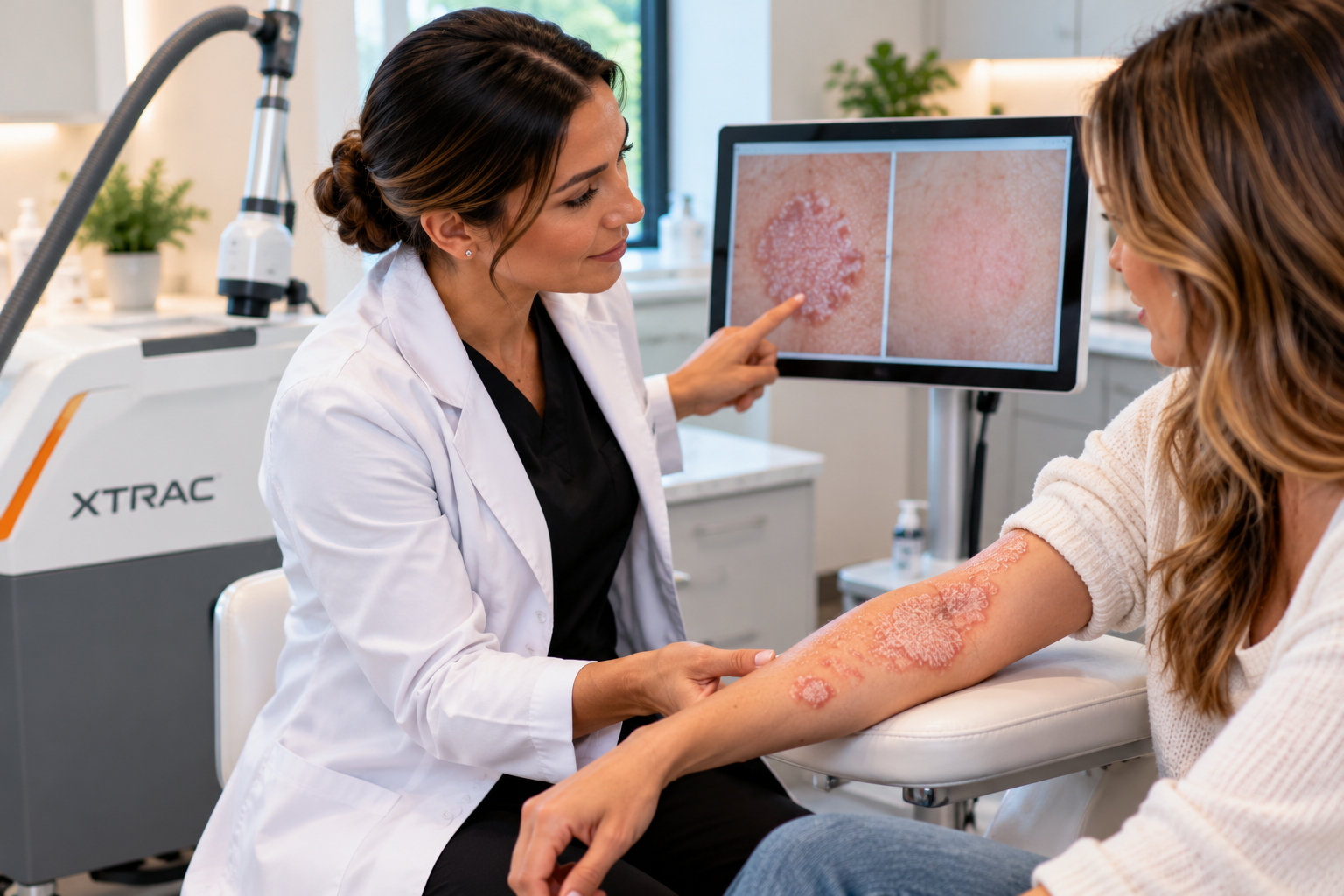
Some psoriasis patches seem to ignore every cream you try. They sit on your elbows, knees, or scalp, flare without warning, and become a constant reminder in short sleeves or under bright lights. If that sounds familiar, you may be wondering whether laser treatment could help.
For many people with limited, stubborn plaques, it can. XTRAC is a targeted light treatment that delivers concentrated ultraviolet light directly to psoriasis patches while largely sparing the surrounding healthy skin. It is not right for everyone, and it requires a commitment to regular sessions, but for the right patient it can be a valuable part of a psoriasis treatment plan.
Dermatology Associates of Georgia offers XTRAC laser treatment as part of its physician-led medical dermatology care, alongside comprehensive psoriasis management.
What Is Psoriasis, and Why Are Some Patches So Hard to Treat?
Psoriasis is a chronic autoimmune skin condition. The practice's psoriasis page explains that the immune system speeds up skin cell production, leading to thick, red, inflamed patches covered with silvery scales, known as plaques. These commonly appear on the elbows, knees, scalp, and lower back, and can also affect the nails, palms, soles, and genitals.
Some patches respond well to topical treatment. Others become persistent, especially on areas with thicker skin or areas that are hard to treat with creams, such as the scalp. These stubborn plaques are often where targeted light therapy enters the conversation.
What Is XTRAC Laser Treatment?
XTRAC is a brand of excimer laser, a type of targeted phototherapy. According to the American Academy of Dermatology (AAD), the excimer laser is a form of narrowband UVB light that dermatologists use to target only the psoriasis, rather than exposing large areas of healthy skin (AAD: Phototherapy for Psoriasis).
The practice's XTRAC laser treatment page describes it as a non-invasive treatment for psoriasis, vitiligo, and atopic dermatitis that can address stubborn plaques and hard-to-treat areas, including the scalp, palms, feet, back, elbows, and knees. Sessions typically take 5 to 20 minutes, depending on the size and number of areas treated, with minimal to no downtime.
Who Is a Good Candidate for XTRAC?
XTRAC tends to be a good fit for people whose psoriasis is limited to specific patches rather than widespread across the body. You may be a candidate if:
- You have stubborn plaques on areas like the elbows, knees, or scalp
- Topical treatments have not provided enough improvement
- You prefer a targeted option that spares surrounding healthy skin
- You can commit to a consistent treatment schedule
The AAD notes that the excimer laser can treat psoriasis on the scalp, ears, armpits, groin, buttocks, elbows, and knees in both children and adults.
Who may not be a candidate?
Phototherapy is not recommended for everyone. The AAD advises against it for people with a history of melanoma or other skin cancers, certain conditions that raise skin cancer risk, conditions that increase sensitivity to UV light such as lupus, or those taking medications that increase UV sensitivity, including some antibiotics, diuretics, and antifungals. Be sure to share your complete medical history and medication list during your consultation.
How Many XTRAC Sessions Will You Need?
Excimer laser treatment works through repeated sessions rather than a single visit. The AAD notes that most patients need two or three sessions per week for several weeks, with some needing more, and that progress is typically reviewed after about four to six initial treatments.
Consistency matters. The AAD reports that missing more than two appointments makes benefit unlikely, so it helps to plan your schedule before you begin.
How Do Real-Life Schedules Affect Psoriasis Treatment?
The best psoriasis treatment is one you can actually stick with, and that looks different depending on your stage of life.
Busy professionals: making the schedule work
For working professionals, the biggest question about XTRAC is not the treatment itself but the commitment. Two or three short visits a week can feel like a lot during a demanding season at work. The upside is that sessions are brief, often 5 to 20 minutes, and there is minimal downtime, so many people fit appointments in before work, at lunch, or on the way home. If you work near Emory, Druid Hills, or along the Clairmont Road corridor, the Decatur office's location can make that routine more realistic. Before starting, look at your calendar for the next several weeks and identify any travel or deadlines that might lead to missed sessions.
Stress is also a well-recognized psoriasis trigger, which means busy seasons can sometimes bring flares. Our article on what triggers psoriasis flare-ups explores this connection.
Younger adults: visible patches and confidence
For people in their twenties and thirties, visible plaques on the elbows, knees, or hairline can affect confidence at the gym, at work, or in social settings. Targeted treatment for these stubborn areas can be appealing because it focuses on the patches that bother you most. Psoriasis is a chronic condition, and having a dermatology team that understands both the physical and emotional side of it can make long-term management feel more manageable.
What Are the Side Effects of Excimer Laser Treatment?
The practice describes XTRAC as involving minimal discomfort and little to no downtime. The AAD notes that possible immediate side effects of phototherapy include sunburn-like redness or tenderness, mild stinging or burning, itching, dark spots (which are more common in medium to dark skin tones), and, rarely, blisters. Mild pinkness after a session is expected.
Over the long term, the AAD notes that phototherapy may contribute to freckling, signs of skin aging, and an increased risk of skin cancer, which is why treatment is supervised by a dermatology team and regular skin checks remain important.
The AAD also advises not applying salicylic acid before treatment, since it can make UVB less effective. Your provider will give you specific preparation instructions.
What Can You Do Between XTRAC Sessions?
Your habits between appointments can support your progress. While your provider's instructions always come first, these general steps can help:
- Keep every scheduled session, since consistency is closely tied to results
- Avoid applying salicylic acid before treatment unless your provider says otherwise
- Tell your care team about any new medications, including antibiotics, since some increase sensitivity to UV light
- Keep your skin moisturized and avoid picking or scratching plaques
- Mention any unusual redness, blistering, or discomfort at your next visit
Can XTRAC Help Skin Conditions Other Than Psoriasis?
The practice's XTRAC page also lists vitiligo and atopic dermatitis among the conditions it can address. If you live with eczema as well as psoriasis, or are unsure which condition is causing your symptoms, an evaluation can clarify the diagnosis. Learn more on the practice's eczema page.
How Does XTRAC Fit Into a Complete Psoriasis Treatment Plan?
XTRAC is one tool among many. Depending on the extent and severity of your psoriasis, a dermatologist may recommend topical treatments, phototherapy, oral medications, or other options, sometimes in combination. Psoriasis can also be associated with joint symptoms, so mention any joint pain or stiffness to your provider.
At Dermatology Associates of Georgia, psoriasis treatment is personalized based on your symptoms, the areas affected, and how your skin responds over time. For a broader look at treatment approaches, see our article on approaches to psoriasis treatment in Decatur.
Coverage for specific treatments varies by plan. Review the practice's insurance information and check with your insurance provider before beginning a course of treatment.
Frequently Asked Questions About XTRAC and Psoriasis Treatment
Does XTRAC laser hurt?
The practice describes XTRAC as involving minimal discomfort. Some people notice mild warmth, stinging, or temporary redness after a session.
How long does each XTRAC session take?
Sessions typically take 5 to 20 minutes, depending on the size and number of areas being treated.
How often do I need XTRAC treatments?
According to the AAD, most patients need two or three sessions per week for several weeks. Your dermatologist will check your progress and adjust your plan as needed.
Can XTRAC treat scalp psoriasis?
Yes. The practice lists the scalp among the areas XTRAC can treat, and the AAD notes that the excimer laser can treat psoriasis on the scalp.
Is XTRAC a cure for psoriasis?
No. Psoriasis is a chronic condition, and there is currently no cure. XTRAC can help improve stubborn plaques, and your dermatologist will help you build a long-term plan for managing flares.
Targeted Light for Persistent Plaques
If a few stubborn psoriasis patches have been running the show, a targeted approach like XTRAC may help you take back control. The key is an accurate evaluation and a schedule you can keep.
To find out whether XTRAC or another psoriasis treatment fits your needs, contact Dermatology Associates of Georgia in Decatur. Visit us at 1951 Clairmont Road, Decatur, GA 30033, call (404) 321-4600, or request an appointment online.


